

What is TDR in Hyderabad Real estate?
TDR (Transferable Development Rights) in Hyderabad is a right given by GHMC (municipal authority) that lets a person or owner build extra floor area somewhere else instead of getting cash when their land is taken for a public purpose.
How it works
- Government or civic body acquires private land for a public project (road widening, riverfront, lake protection, etc.).
- Instead of paying full cash to the owner, the authority issues a TDR certificate to that owner.
- That TDR represents a certain amount of built-up area (square feet or sq yards). The owner can:
- Use the TDR on another plot they own to add extra floors/area (subject to municipal rules), or
- Sell the TDR to a developer or buyer who needs extra built-up rights.
Who issues TDR?
The local municipal corporation or urban local body issues it — for example, GHMC issues TDR in Hyderabad.
What exactly does a TDR let you do?
- It gives permission to build additional built-up area that is over and above the standard limits set by building rules.
- Often, TDR can be used to add extra floors without needing fresh relaxation of setbacks or road-width norms (but exact use depends on local rules).
Key Takeaways New GO on TDR in Hyderabad
The government has revised the earlier TDR rule after pushback from developers. The earlier version was aggressive and created a sudden cost burden. The updated version is more balanced.
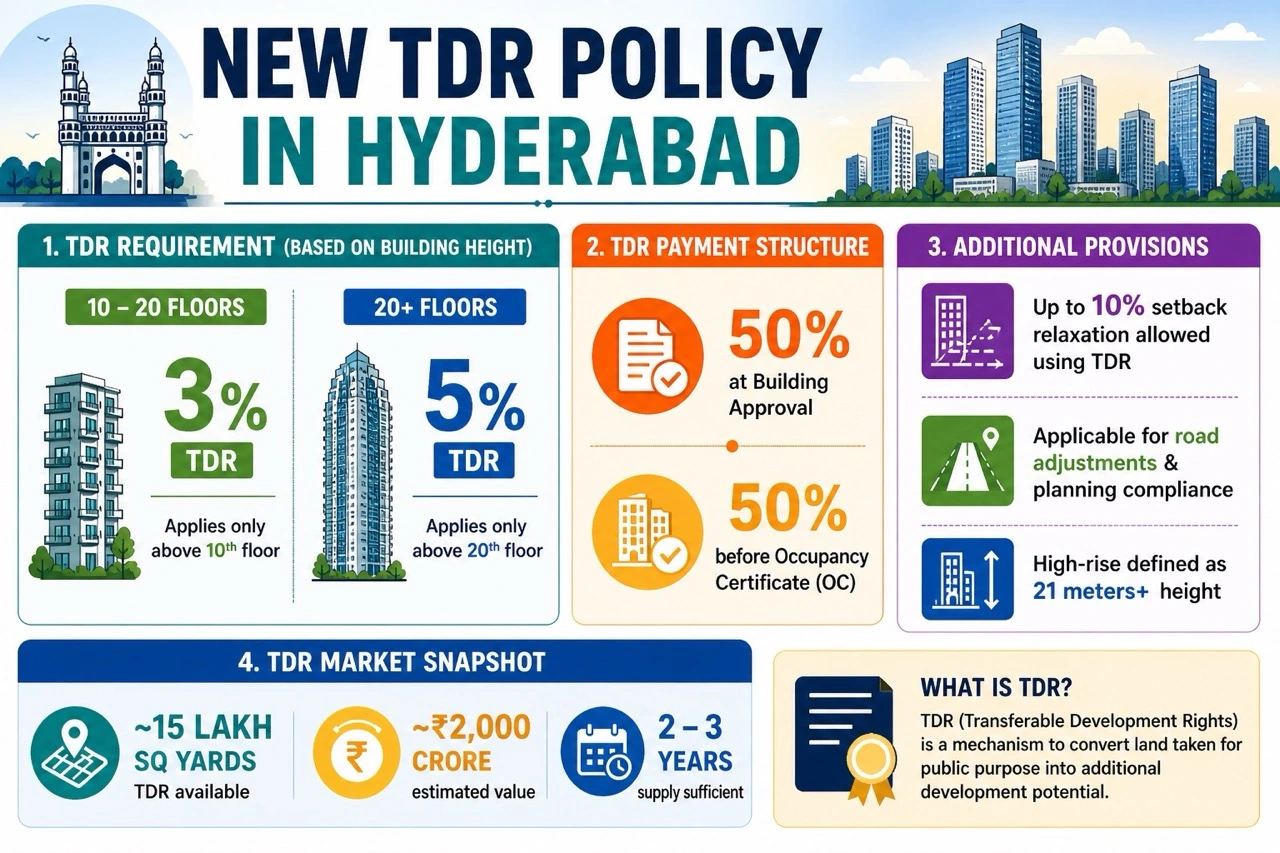
Here’s what has changed:
- The earlier flat 10% mandatory TDR rule has been removed
- A slab-based system is now in place
- 3% TDR applies for buildings between 10–20 floors (above the 10th floor)
- 5% TDR applies for buildings above 20 floors (above the 20th floor)
- Developers can now submit TDR in two stages:
- 50% during approval
- 50% before occupancy
There are also additional relaxations:
- TDR can now be used for setback adjustments (up to 10%)
- More flexibility is given in road alignment and planning compliance
- Certain height permissions now depend on plot size and road width, not just a blanket rule
The city still has a large TDR inventory — enough to support demand for the next couple of years. So supply is not the issue right now. Pricing and absorption are what will move.
What the new GO actually requires and why the state revised it
The original rule tried to force TDR usage across all high-rise developments by mandating a 10% load. Builders pushed back hard because it directly impacted project viability.
The revised rule fixes that.
Instead of treating every high-rise the same, the government now differentiates based on height. Mid-rise high-rises (10–20 floors) carry a lighter obligation. Ultra-tall towers carry a higher one.
This approach does two things:
- Keeps TDR relevant and actively used
- Prevents a sudden spike in construction costs
The state still wants to reduce cash compensation when acquiring land. That goal hasn’t changed. What changed is the way TDR is enforced.
What this means in practice
Let’s say a project has 20 floors:
- Only the portion above the 10th floor is considered
- Out of that portion, 3% must be backed by TDR
For a 30-floor building:
- The portion above the 20th floor attracts 5% TDR
This creates a graduated cost structure, instead of a sudden jump.
Impact on Builders and Developers
This is where the biggest shift has happened.
Under the earlier rule, developers were staring at a sharp cost increase. That made pricing tricky and slowed down decision-making.
Now, things are more workable.
Short-term impact
- Projects with approvals already in place remain largely unaffected
- New approvals and revisions must follow the slab system
- The immediate cost pressure has reduced
The biggest relief is phased TDR submission. Developers don’t need to block capital upfront for the full amount.
Medium-term impact
- High-rise construction remains viable
- Ultra-tall towers still carry higher cost pressure
- Design decisions will now factor in TDR slabs
Builders may start optimizing height — not just maximizing it. In some cases, stopping at certain floors could make more financial sense.
Cost impact (revised view)
The earlier estimate of ₹300–400 per sq ft increase was based on the 10% rule.
With the revised slabs:
- The increase is likely lower and more controlled
- Impact varies by height and micro-market
- Developers may absorb part of the cost instead of fully passing it
What builders should do now
- Recalculate project feasibility using 3% and 5% slabs
- Align cash flow with phased TDR payments
- Lock TDR deals early if pricing starts moving
- Revisit design — height is now a cost decision, not just a branding move
Impact on Buyers
Buyers will still feel the effect, but it won’t be as sharp as initially expected.
The earlier rule would have pushed prices up faster. The revised version softens that impact.
Who will feel it most
- Buyers of new high-rise launches
- Buyers in premium corridors with taller towers
Who benefits
- Buyers of projects with older approvals
- Buyers in mid-rise developments
Price movement
Instead of a broad jump, expect:
- Mild upward adjustments in select projects
- Variation based on tower height
- Limited impact in mid-rise segments
The key difference now is uncertainty has reduced. Builders can price more confidently, and buyers won’t see sudden spikes.
Why prices still move
Even with reduced slabs:
- TDR still has a cost
- Demand for TDR will increase gradually
- That cost will reflect somewhere in pricing
But it won’t be uniform across all projects.
Smart buyer moves
- Check whether the project falls under the new rule
- Understand which slab applies
- Compare with older approvals
- Focus on overall value, not just base price
Impact on Landlords and Investors
From an investor’s perspective, this is more of a market balancing move than a disruption.
The government has kept TDR active without choking supply.
Supply-side view
- High-rise supply will continue
- Ultra-tall projects may slow slightly
- Mid-rise projects could see more traction
The city still has enough TDR stock, so there is no immediate shortage.
Pricing and rental effect
- New supply may come at slightly higher prices
- Older inventory could gain relative advantage
- Rental markets depend more on job hubs than TDR
If rents keep growing in key areas, yields remain stable despite price adjustments.
Resale impact
Projects approved before these changes may:
- Look more attractive in comparison
- See better liquidity in the short term
But the gap won’t be extreme since the rule has been softened.
Investor checklist
- Identify project category (mid-rise vs high-rise vs ultra-tall)
- Track new launch pricing trends
- Focus on micro-market demand, not just regulation
- Avoid overestimating price inflation
Practical steps each stakeholder should take now
Builders / developers
- Segment projects based on height slabs
- Rework cost structures using revised TDR percentages
- Plan cash flows with staggered TDR payments
- Use design strategically to manage cost
Buyers / end-users
- Ask directly: “Which TDR slab applies here?”
- Compare pre-change and post-change projects
- Don’t assume uniform price increase across the market
- Focus on long-term usability and location
Landlords / investors
- Stay flexible with entry and exit timing
- Track how new supply is priced
- Watch demand in employment-driven areas
- Position older inventory strategically
Frequently asked questions (FAQs)
A: The earlier version created too much cost pressure. The revised version keeps TDR relevant while making projects viable.
A: 3% for 10–20 floors (above 10th), 5% for 20+ floors (above 20th).
A: Yes, but only as per the new slab structure, not a flat 10%.
A: Slightly in some high-rise projects, but not uniformly across the market.
A: Builders (due to lower burden), buyers (due to stable pricing), and TDR holders (due to steady demand).
A: Mainly new approvals and revised plans.
A: Yes, current stock can support demand in the near term.
A: Not necessarily, but they will be more selective.
A: Yes, including setback flexibility and certain planning adjustments.
A: Approval status, height category, and actual value—not just regulatory impact.